From a notebook in every branch to one ledger for ten
A Saudi tailoring chain with ten branches and a workshop ran its orders, deposits and measurements on notebooks, WhatsApp threads and staff memory. We built it one system on Odoo 20 that starts on a tablet at the branch and ends in one set of accounts and one payroll: a tailoring-order screen with photo, measurements and deposit, a workshop that sees its own work, two automatic WhatsApp messages, and one ledger for every branch — then turned it into a ready product any chain can run in fifteen working days.
10
branches, one ledger
2
automatic WhatsApp messages per order
0
manual entry at head office
15
working days to go-live
0
per-user licence fees
The system — from the branch counter to the ledger
A till knows the sale; it does not know the order. So we built the system on the order itself: one card carrying the fabric photo, the measurements, the date and the deposit, moving from branch to workshop to customer — with the accounting entry and the tailor's productivity card following it.
The branchTablet · customer · photo · measurements · date · deposit
→
The buildOne system on Odoo 20Tailoring order · workshop · WhatsApp · POS · accounting · payroll
→
Customer & head officeA message on his phone · an entry in the branch ledger · one screen for management
↓
Order screenMeasurement fileWorkshop boardWhatsApp BusinessPOS & receiptAccounting by branchE-invoicingAttendancePayroll & WPS
Ten branches · one workshop · Arabic / English · ZATCA · Odoo 20 Community with NYOTA modules
01 The client
A men's-thobe tailoring chain in Saudi Arabia: ten branches, a workshop, and around fifty staff between cashiers, tailors, pressers and management. The customer brings his fabric or picks from the shop's, his measurements are taken, a date is agreed, a deposit is paid in cash or by transfer, and he waits for a phone call saying the thobe is ready.
The owner asked for three things: a till in every branch, one set of accounts, and one HR — and for the customer to get a message when his order is received and when it is ready.
02 The core problem
One order lived in four places
The fabric in the workshop, the measurements in the branch notebook, the date in an employee's head, the deposit in the cash drawer. None of them knew about the others. When the customer called to ask "ready?", the branch called the workshop to find out; when the same customer came back a year later, his measurements were taken again because they were in another branch.
At head office, nobody knew at any moment how many orders were open in each branch, how much deposit money had been taken against them, or who was late. Month-end numbers were collected from the branches by hand, payroll for fifty people on different wages and allowances was worked out on paper, and the wage-protection file was rebuilt every month.
Then Ramadan arrives, orders triple, and so does all of the above.
Ten branches, and the owner only knows how many orders are open by calling each one — and the deposits? In the notebook.
03 The approach
Build on the order, not the invoice
A standard till knows the invoice, not the order. So we made the tailoring order the first-class object: one card carrying the customer, the fabric photo, the measurements, the services, the date and the deposit, with stages it moves through from branch to workshop to delivery. Everything else — the message, the entry, the receipt, the productivity card — is generated from it and never keyed in twice.
We then chose Odoo 20 Community deliberately and completed it with NYOTA's own modules: WhatsApp Business over Meta's Cloud API, Saudi payroll, accounting close. No per-user or per-employee licence fees, however many branches are added.
1
Order first
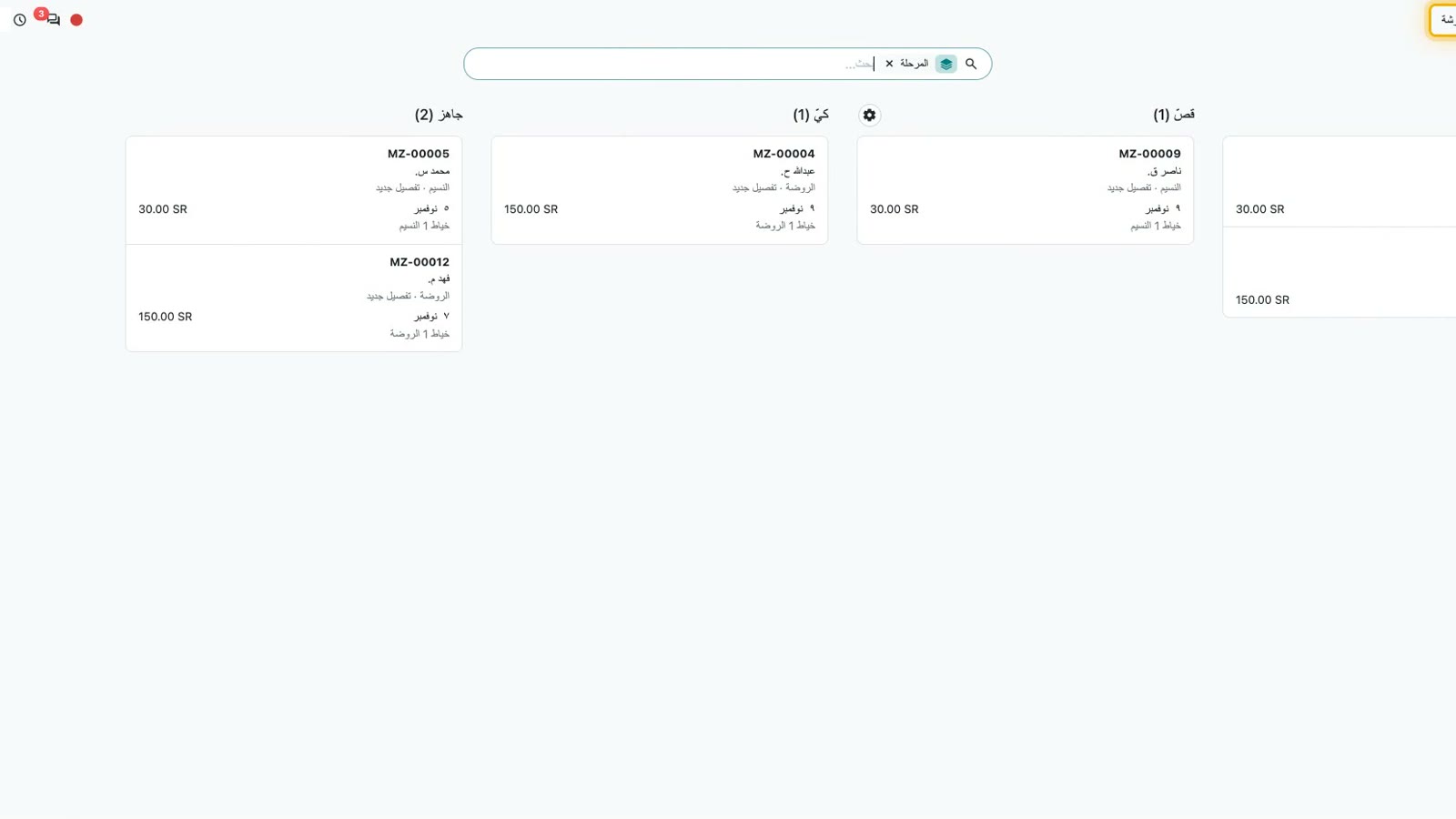
A tailoring-order model with five stages — received, cutting, sewing, pressing, ready — plus its photos, measurements and payments, seen by branch, workshop and head office from the same card.
2
The message follows the stage
Moving the card to Received, Ready or Added-after-fitting is what fires the customer's WhatsApp message; staff type nothing, and the message is logged on the order with its time and delivery status.
3
The entry follows the payment
Every payment at a branch becomes a receipt in that branch's cash or bank journal at that moment; the deposit sits as a customer advance until delivery, and nothing is delivered while a riyal is still due.
4
Pilot in two, then roll out
Go-live in two branches before all ten, a signed hand-over for each phase, and Arabic training videos recorded from the system's own screens for every role.
Build the system on what actually happens at the counter — not on what the invoice knows.
04 The solution
One system from branch to ledger — on Odoo 20 with NYOTA modules
The tailoring-order screen at the branch
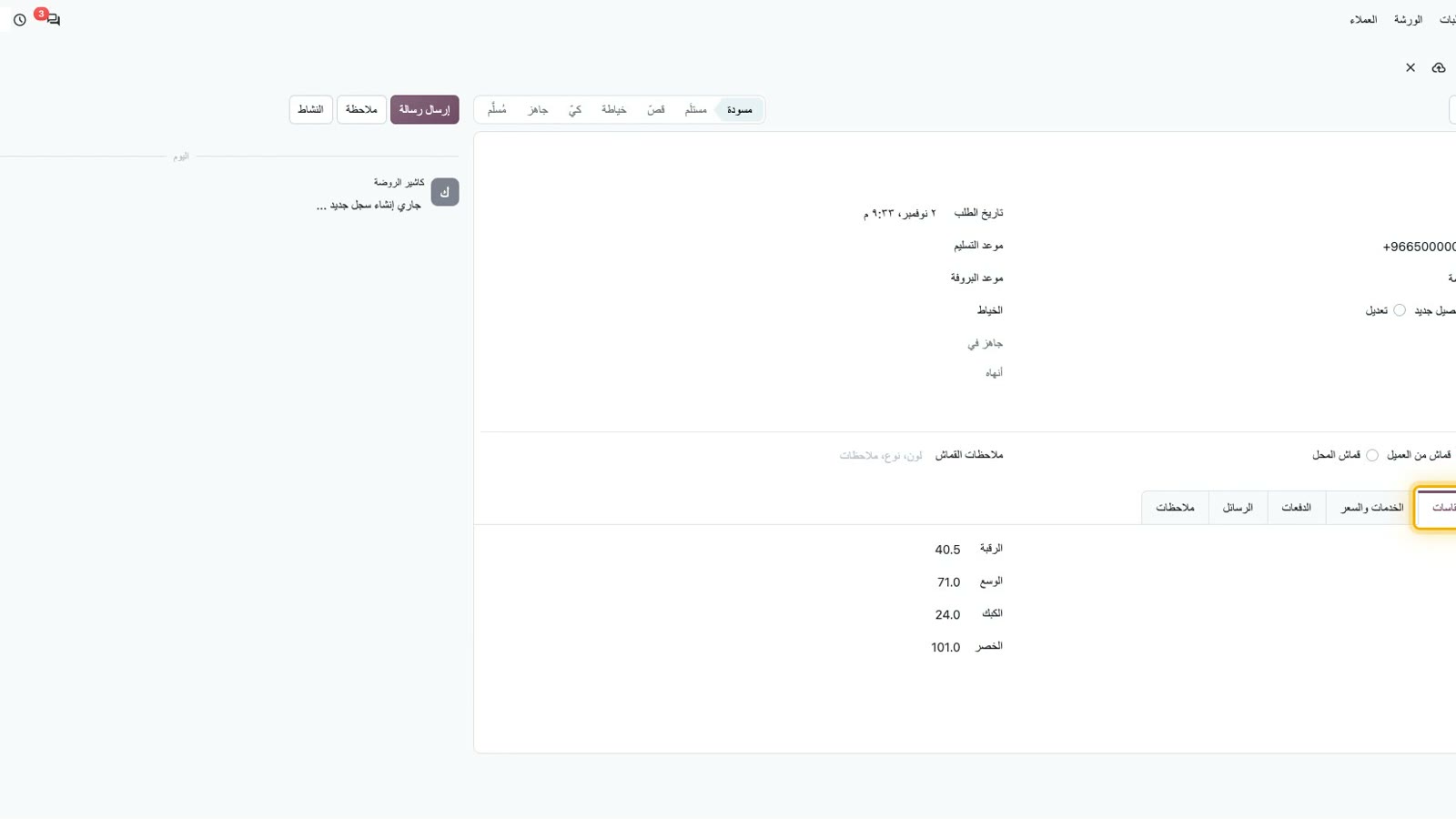
On the tablet: the customer by phone number, service type, fabric source, photos of the fabric or garment from the device camera, and a fixed measurement sheet saved to the customer's file and recalled on every new order in any branch. Delivery date, services and prices, the deposit in cash, card or transfer, and an 80 mm receipt with the order number, paid and balance.
The workshop
A stage board where every tailor sees his own work on his phone and moves the card when he is done. Each step is logged with his name and time, so each tailor's and each branch's output comes out of the same cards with no extra entry. Changes after the fitting are a line on the same order, paid or free, sending it back to the workshop and re-firing the messages.
WhatsApp Business
NYOTA's module on Meta's Cloud API, with a number in the company's name and approved templates for received, ready and added-after-fitting. Fired by the order's stages, logged on the order with time and delivery status, and held safely while the number is not yet connected.
The till
Odoo Point of Sale in every branch for ready-made pieces, accessories and fabric by the metre, with sessions, cash control and closing. Tailoring orders appear in the same POS and their deposits count in the session's cash, so the drawer closes on one correct number.
Accounting
One ledger for all branches: a cash journal, a bank journal and a cost centre per branch, every payment a receipt at that moment. The head-office accountant sees branch payments, entries and cash boxes without asking anyone; e-invoicing and the VAT return come from the same entries, with NYOTA's close and bank-reconciliation modules.
HR and payroll
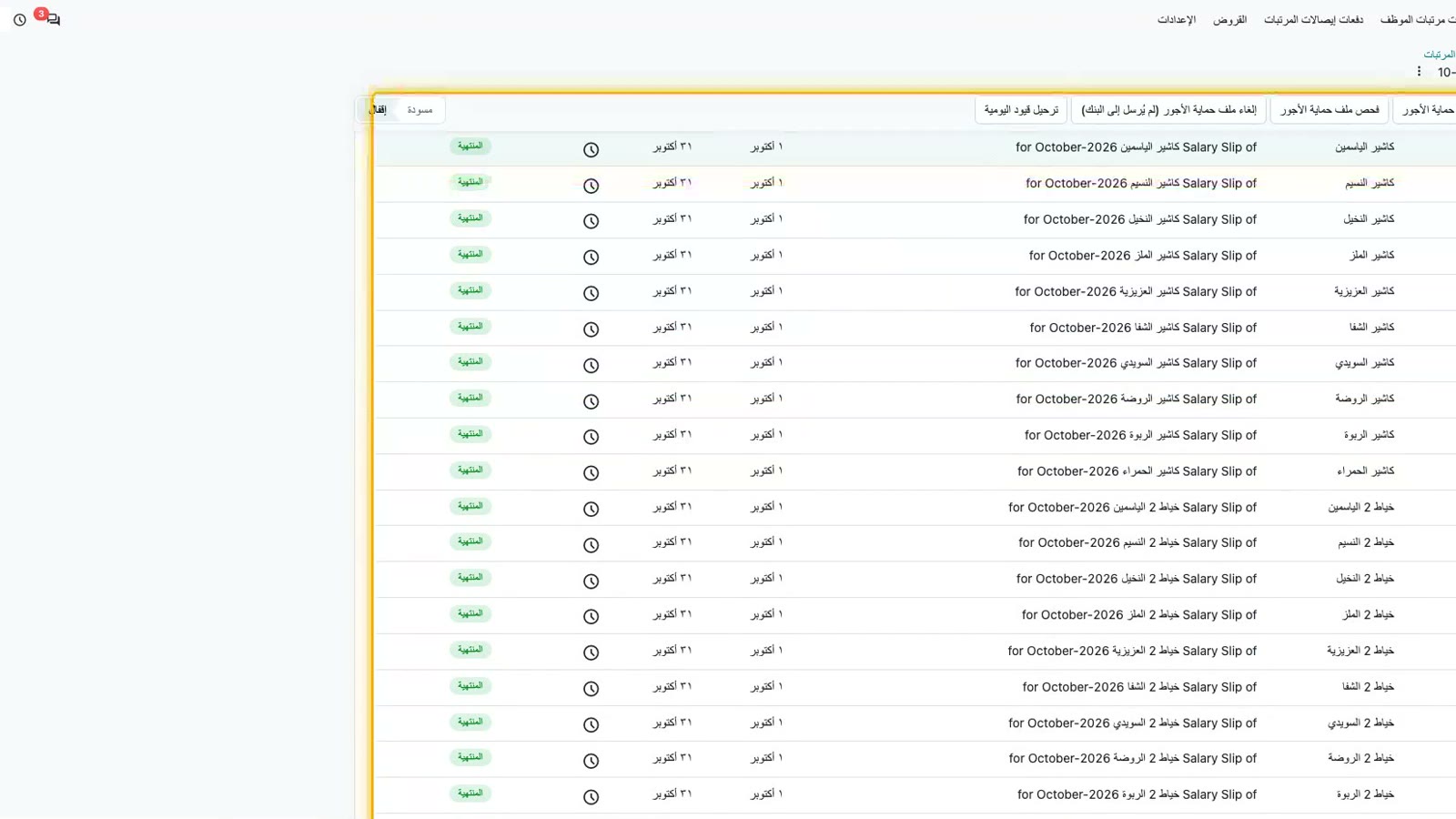
A file for every employee and tailor with his branch, contract and documents, attendance from the branch device by employee code, leave by request and approval. Payroll by NYOTA's module under Saudi labour law — allowances, GOSI, end of service, overtime, loans — one monthly batch for all branches posting to accounting, with the wage-protection file exported from the same batch.
05 The result
The order taken at the branch is the same card in the workshop, the same entry in the accounts, and the same productivity card in the tailor's file. A full order with photo, measurements and deposit now takes ninety seconds instead of five to ten minutes on paper, the customer hears about his order twice without asking, and the accountant keys in nothing at head office.
The owner sees ten branches on one screen from his phone: open and late orders, today's sales in cash and bank, deposits taken and balances due, workshop output and attendance. The month's payroll for every branch is one batch computed in minutes, with the wage-protection file coming out of it.
And because the system was built on the order rather than on one client's name, it became a product: it runs for any tailoring or alteration chain in fifteen working days, at a published price starting from ten thousand riyals, with no per-user licence fees. The figures above are from the operating model on a ten-branch environment with demo data; they are replaced with the client's own after the first month.
Why it matters
This is not installing a till in ten shops — it is rebuilding a whole working cycle around the object the shop actually lives on: the order. Once the order is the centre of the system, the message, the entry, the receipt and the payslip follow on their own, and what was a project for one client becomes a product any chain can run in weeks, not months.
Not installing software — engineering the order a shop runs on. That's the work.
Run tailoring or alteration branches?
The product is ready and filmed: watch it work, then we set it up on your branches in fifteen working days. Product page, film and price (Arabic).